

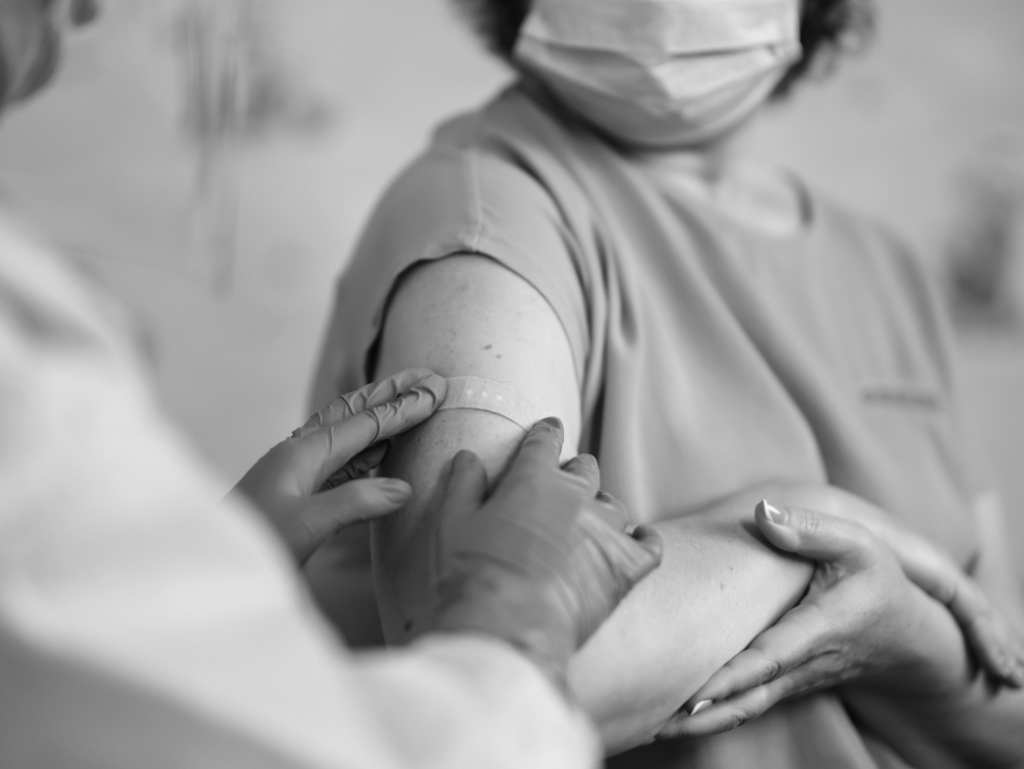
Breastfeeding and vaccination in Kansas
Breastfeeding and Vaccination
Understanding why vaccine awareness matters for breastfeeding parents.
Breastfeeding supports the health of both the child and the breastfeeding parent. When you’re breastfeeding, vaccination is essential for protecting yourself as well as your baby.
Not only does breastfeeding provide important nutrients, but when the breastfeeding parent receives a vaccine, they can share life-saving antibodies with the child through breast milk. This is true for regular vaccinations and for COVID-19 vaccines.
Vaccinations are a critical step in protecting the health of your child.
At the Kansas Breastfeeding Coalition, we’re committed to helping breastfeeding families with accurate information about breastfeeding vaccination in Kansas and its impacts on breastfeeding.
Protect Yourself, Protect Your Baby
Two-generational protection is at the core of our Protect Yourself, Protect You Baby campaign to increase COVID vaccination rates among the over 31,500 breastfeeding parents in Kansas each year. This statewide campaign was co-created with trusted Black, Indigenous, and Latinx community champions. This “grassroots” to “grass-top” approach will ensure parents receive accurate information to make an informed decision regarding the COVID vaccine.

Resources about breastfeeding and vaccination
- Articles
-
Drugs and Lactation Database (LactMed®): National Institute of Child Health and Human Development; Vaccines. [Updated 2023 Jan 19].
Vaccines, pregnancy, menstruation, lactation, and fertility (World Health Organization, video)
Safety and Efficacy of Coronavirus Disease 2019 (COVID-19) mRNA Vaccines During Lactation (March 2023)
Milk antibody response after 3rd dose of COVID-19 mRNA vaccine and SARS-CoV-2 breakthrough infection and implications for infant protection (BMJ, Dec. 2022)
Detection of SARS-CoV-2 IgA and IgG in human milk and breastfeeding infant stool 6 months after maternal COVID-19 vaccination (JP, Jan. 2023)
Increase in COVID Antibodies Following Booster Vaccinations (JHL, Nov. 2022)
COVID-19 Drugs and Breastfeeding Update (ABM, Nov. 2022)
Analysis of Vaccine Reactions After COVID-19 Vaccine Booster Doses Among Pregnant and Lactating Individuals (JAMA, Sept. 2022)
Detection of Messenger RNA COVID-19 Vaccines in Human Breast Milk
- Videos
-
- Testimonial from a mom
- Presentation by Tandem Knight, RN
- Presentation by Chela Love, DNP, APRN
- Presentation by Jessica Calvo Castanon, MD, FAAP (Spanish)
- Ask a Midwife: If I Am Breastfeeding Can I Get a COVID Vaccine? (English and Spanish)
- Get Your Shot
This two-generational protection is at the core of the Protect Yourself, Protect You Baby campaign to increase COVID vaccination rates among the over 31,500 breastfeeding parents in Kansas each year. A statewide campaign will be created with trusted champions within the Black, Indigenous, and Latinx communities to reach breastfeeding parents in their communities. Social media, image and video libraries, live stream events, and social messaging will be used to combat misinformation and address breastfeeding parents’ concerns about receiving a COVID vaccine. This “grassroots” to “grass-top” approach will ensure parents receive accurate information and are able to talk with trusted sources from a wide range of backgrounds, programs, and systems, to make an informed decision regarding the COVID vaccine.
This Increase the Reach grant program is supported by the Centers for Disease Control and Prevention (CDC) of the U.S. Department of Health and Human Services (HHS) as part of a financial assistance award totaling $79,278,482 with 100 percent funded by the CDC/HHS. The contents are those of the author(s) and do not necessarily represent the official views of, nor an endorsement, by the CDC/HHS, or the U.S. Government. For more information, please visit https://www.cdc.gov/. v10-01-2021
- Resources for Lactation Support Providers: Webinars
-
COVID-19: Infant Feeding during the Postpartum Period (Webinar Recording), Dr. Aunchalee Palmquist
Going Home During a Pandemic: Challenges for Breastfeeding Families (May 13, 2020)
Integrating Practices for COVID-19+ and PUI Parents (4/20/20) California Breastfeeding Coalition
Lactation Education Resources has posted archived presentations on lactation support and COVID-19
Live Q&A session on COVID-19 with human milk lactation experts. The International Society for Research in Human Milk and Lactation (ISRHML)
Making the Shift from In-Person to Virtual Care & Support (California Breastfeeding Coalition)
Providing the best possible solutions in less-than ideal circumstances: Integrating hospital practices for COVID-19 positive and PUI birthing parents with consideration of infection control and Baby-Friendly practices: (California Breastfeeding Coalition)
- Resources for Lactation Support Providers: Telehealth & Sample Policies
-
Telehealth Resources:
Telehealth Resources & Tips, Lactation Education Resources
Phone Triage Algorithm for Determining Home Visit or Telehealth Visit, Lactation Education Resources
IBLCE Advisory Opinion on Telehealth – The International Board of Lactation Consultant Examiners advisory addresses the provision of lactation consulting services via telehealth
Nurse Family Partnership: COVID-19 Telehealth Guidance
Seven Strategies for Conducting Services Virtually, NICHQ
Sample Policies:
COVID-19 & Breast Milk Expression and Breast Milk Feeding for PUIs *sample policy (3/31/20)
Handling of breast milk from COVID-19 mothers *sample policy (3/31/20)
Sample Informed Consent Form for Refusal to Separate Birthing Parent and Infant
- Resources for Lactation Support Providers: General
-
Academy of Breastfeeding Medicine
ABM Statement On Coronavirus 2019 (COVID-19)
Should Infants Be Separated from Mothers with COVID-19? First, Do No Harm
Breastfeeding and Respiratory Antivirals: Coronavirus and Influenza
American Academy of Family Physicians
AAFP Statement on Breastfeeding and COVID-19
The American Journal of Maternal/Child Nursing
Pregnant Women’s Reports of the Impact of COVID-19 on Pregnancy, Prenatal Care, and Infant Feeding Plans. The article includes descriptions of how the COVID-19 pandemic has affected pregnancy, prenatal maternity care practices, and infant feeding plans among pregnant women in the United States. The authors emphasize the need for healthcare providers and policymakers to listen to the collective voices of women about how COVID-19 has affected their birth and infant feeding plans, and their perceptions of changes in prenatal care.
Carolina Global Breastfeeding Institute
COVID-19 Handling Expressed Human Milk (pdf)
Centers for Disease Control and Prevention (CDC)
Human Milk Banking Association of North America
Milk Handling for COVID-19 Positive or Suspected Mothers in the Hospital Setting
Why Donor Human Milk is an Essential Need During COVID-19
International Board of Lactation Consultant Examiners:
IBLCE Advisory Opinion on Telehealth
The International Lactation Consultant Association
Resources for Skilled Lactation Providers on COVID-19
Providing Lactation Support During the COVID-19 Pandemic: Q&A With Annie Frisbie, Practicing in New York, US (ILCA Blog)
Journal of Human Lactation
Lactation Education Resources
Resources for Lactation Supporters During COVID-19
Maternal & Child Nutrition
Experiences of breastfeeding during COVID‐19: Lessons for future practical and emotional support. The authors conducted an online survey of breastfeeding mothers about the effects of the COVID-19 lockdown on breastfeeding experiences in the UK. The authors found that some mothers felt that breastfeeding was protected due to lockdown, while others struggled to get breastfeeding support.
The National WIC Association
Breastfeeding and COVID-19 Guidance
UNICEF
U.S. Agency for International Development
Infant and Young Child Feeding Recommendations When COVID-19 is Suspected or Confirmed – 10 Counselling Cards and a Recommended Practices Booklet, reflect the global recommendations from WHO and UNICEF (March 2020) on IYCF in the context of COVID-19
United States Breastfeeding Committee
COVID-19 and Breastfeeding Guide for Parents
Statement on Pasteurized Donor Human Milk & COVID-19
U.S. Agency for International Development (USAID)
Key Messages Related to Evidence on Transmission of COVID in Breastmilk. USAID The brief includes key messages on research related to COVID-19 transmission through human breast milk.
World Health Organization
Breastfeeding advice during the COVID-19 outbreak (infographics)
FAQs Breastfeeding and COVID-19 For health care workers (pdf)
Q&A on COVID-19 and breastfeeding
Other
- General Information on Coronavirus, Pregnancy, and Childbirth
-
Sample Informed Consent Form for Refusal to Separate Birthing Parent and Infant
American Academy of Pediatrics
AAP Perinatal COVID-19 Registry
FAQs: Management of Infants Born to Mothers with Suspected or Confirmed COVID-19 (updated 7/22/2020)
Baby-Friendly USA
Centers for Disease Control and Prevention (CDC)
Harvard Medical School
COVID-19: Separating Infected Mothers from Newborns: Weighing the Risks and Benefits
Journal of the American Medical Association: Pediatrics
Outcomes of Neonates Born to Mothers With Severe Acute Respiratory Syndrome Coronavirus 2 Infection at a Large Medical Center in New York City. The article concludes that during the COVID-19 pandemic, separation of affected mothers and newborns may not be warranted, and direct breastfeeding appears to be safe.
Kansas Department of Health and Environment (KDHE)
FAQ COVID-19 for Pregnant Women and Infants (English)
FAQ COVID-19 for Pregnant Women and Infants (Spanish)
UNICEF
Coronavirus disease (COVID-19): What parents should know
U.S. Agency for International Development
Infant and Young Child Feeding Recommendations When COVID-19 is Suspected or Confirmed – 10 Counselling Cards and a Recommended Practices Booklet, reflect the global recommendations from WHO and UNICEF (March 2020) on IYCF in the context of COVID-19
U.S. Department of Agriculture, Food and Nutrition Service
FNS Program Guidance on Human Pandemic Response
World Health Organization
Breastfeeding advice during the COVID-19 outbreak (infographics)
Breastfeeding and Covid19 YouTube Video. (28 May 2020).
- Resources for Maternity Care Providers
-
The American College of Obstetricians and Gynecologists
COVID-19 FAQs for Obstetrician-Gynecologists, Obstetrics
The American College of Obstetricians and Gynecologists and Society for Maternal-Fetal Medicine
Centers for Disease Control and Prevention (CDC)
Sample Informed Consent Form for Refusal to Separate Birthing Parent and Infant
National Perinatal Association and the National Association of Neonatal Nurses
Mothers with COVID-19 and Their Newborn Infants – Issue: Shared Decision Making
World Health Organization
Breastfeeding advice during the COVID-19 outbreak (infographics)
- Research Studies
-
Breastfeeding during the COVID-19 pandemic – a literature review for clinical practice
Breastfeeding mothers with COVID-19 infection: a case series
Mistakes from the HIV pandemic should inform the COVID-19 response for maternal and newborn care
Cochrane COVID-19 review of national clinical practice guidelines for key questions relating to the care of pregnant women and their babies. https://pregnancy.cochrane.org/news/covid-19-review-national-clinical-practice-guidelines-key-questions-relating-care-pregnant [pregnancy.cochrane.org]
Karen Puopolo, MD, PhD, FAAP, Chief, Section on Newborn Medicine at Pennsylvania Hospital, Member of the AAP Committee on Fetus & Newborn
Lackey KA, Pace RM, Williams JE, Bode L, Donovan SM, Järvinen KM, Seppo A, Raiten DJ, Meehan CL, McGuire MA, McGuire MK. SARS-CoV-2 and human milk: what is the evidence? doi: https://doi.org/10.1101/2020.04.07.20056812 [doi.org] [preprint prior to peer review]
Kimberlin DW, Puopolo KM. Breastmilk and COVID-19: What Do We Know? [Published online ahead of print, 2020 Jun 21]. Clin Infect Dis. 2020;ciaa800. doi:10.1093/cid/ciaa800 https://www.ncbi.nlm.nih.gov/pmc/articles/PMC7337725/ [ncbi.nlm.nih.gov]
Salvatore CM, Han J-Y, Acker KP, Tiwari P, Jin J, Brandler M, Cangemi C, Gordon L, Parow A, DiPace J, DeLaMora P. (2020). Neonatal management and outcomes during the COVID-19 pandemic: An observation cohort study. Lancet Child Adolesc Health. https://www.thelancet.com/journals/lanchi/article/PIIS2352-4642(20)30235-2/fulltext [thelancet.com]
Get Involved With The KBC Today!
We regularly advocate for necessary breastfeeding support in Kansas. Join us in breaking down barriers to breastfeeding!

Frequently Asked Questions
- Is it safe to get vaccinated while breastfeeding?
-
Even while breastfeeding, vaccination is safe and protects your health, as well as the health of your infant.
- Can I breastfeed if I have COVID?
-
It’s unlikely that you will spread COVID to your baby through your breastmilk. Washing your hands and wearing a mask while breastfeeding or pumping can mitigate risk.
- Should I get vaccinated while breastfeeding?
-
Your healthcare provider is the best resource for your specific situation. Generally, getting vaccinated while you’re breastfeeding is safe and common practice for the flu, whooping cough, and other common illnesses.